18 in x 29 in
2/2026
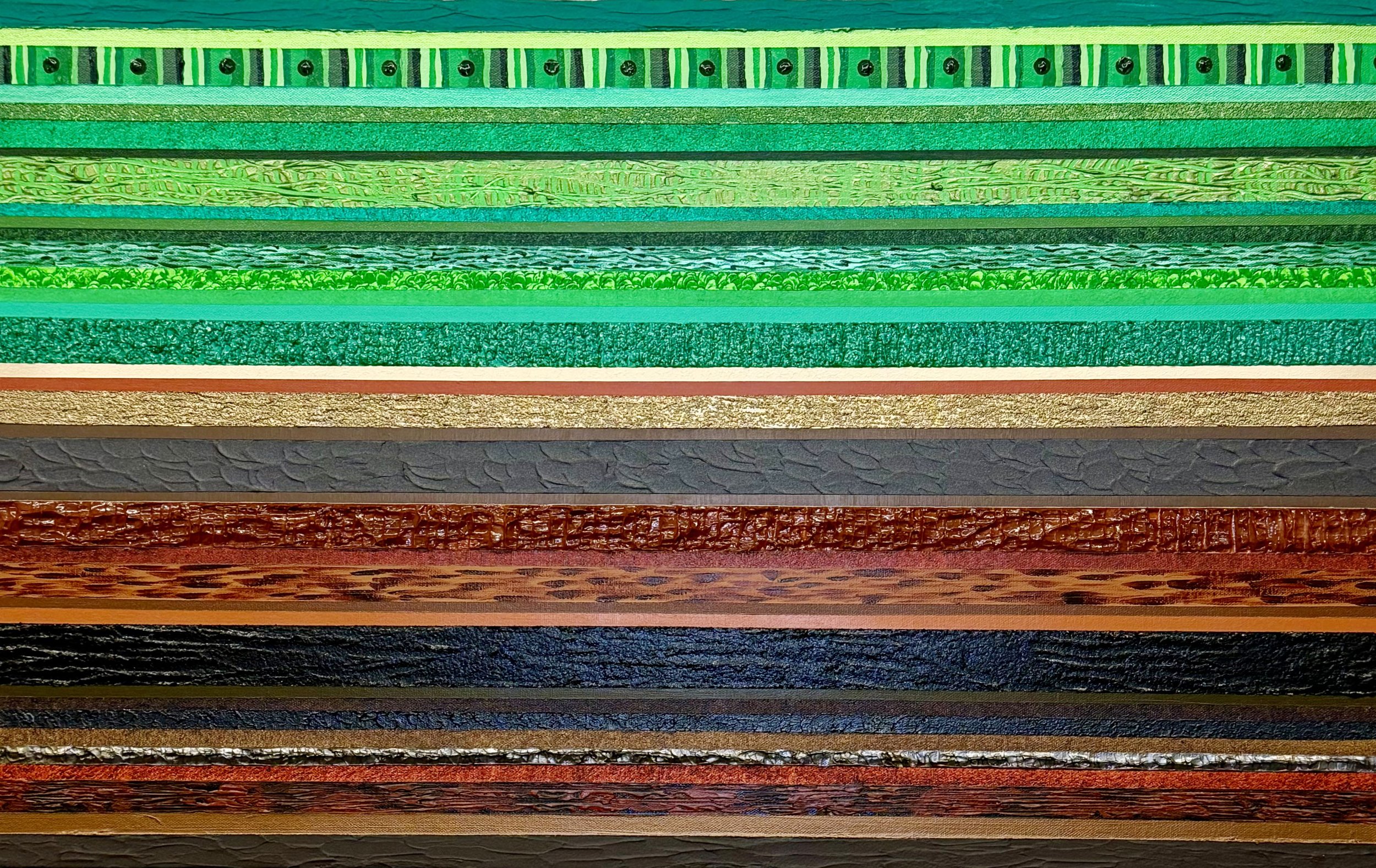
“Strata of a Living Earth” reads as a horizontal cross‑section through the planet, translating geology and ecology into color and texture. The stacked bands move from deep, dark, almost stony or lava‑like layers at the bottom toward increasingly luminous greens at the top, suggesting a gradual ascent from bedrock and mineral deposits to fertile soil and finally to dense surface vegetation. Each band is discrete yet contiguous, and the textural variations in surface treatment—crackling, ridged, glossy, or matte—imply different densities, moisture levels, and organic content. The colors used were chosen to be representative of different layers of the land from deep down in the earth to what's on top of the surface. The lower zones lean into charred blacks, umbers, and iron‑rich reds, evoking heat, compression, and geological time, whereas the upper greens feel oxygenated and photosynthetic - a band of life dependent on and derived from inorganic substrate below. Metallic strips hint at the preciousness of resources we extract from below. The unspoken environmental subtext is that what appears as stable ground is in fact a dynamic interplay of interdependent processes. The flourishing greens at the surface are contingent on what lies beneath. In this way, “Strata of a Living Earth” serves as a contemplative diagram of our planet’s layered, living body.